Diagnostic Tool
Find what's slowing your business down.
Analysing your answers...
Your starting point:
Why this is the priority
Our experience is best enjoyed in portrait mode.

Use practical tools and calculators to get clearer on your offers, pricing, and next steps. No theory. Just clarity.
Built from real work with real service businesses.
If the results raise questions, that’s where we help. See how BLAST closes the gaps.
Select a checkup to turn overwhelm into clear action.
What should I actually focus on first to stop feeling behind?
How much support do I actually need right now?
Sustainable or burnout?
Where are you guessing?
What exactly should you sell, and to who?
Are you ready for a client influx tomorrow?
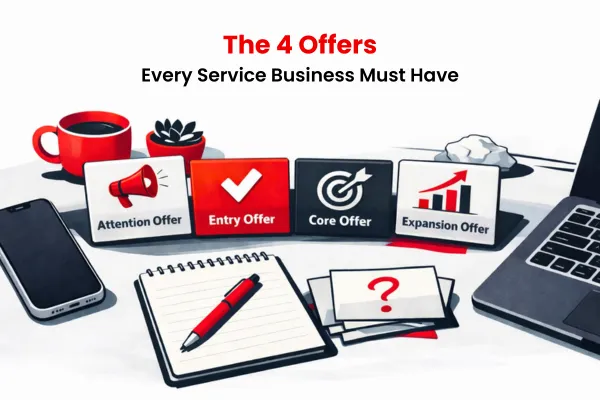
The 4 offers every service business should have are an attention offer, entry offer, core offer, and expansion offer. Each one does a different job in helping people move from first interest to buying, getting results, and taking the next step with you. When these offers are clear, your business becomes easier to understand, easier to sell, and easier to grow.
The 4 offers in a service business are:
Attention offer
Entry offer
Core offer
Expansion offer
These four offers create a simple path. The attention offer helps people find you. The entry offer gives them a first paid step. The core offer delivers the main result. The expansion offer gives them a natural next step after that.
A service business needs 4 offers because one offer alone often cannot do everything well. One offer usually cannot attract attention, build trust, make the sale, deliver the work, and create an upsell all at once. When each offer has a clear role, your customer journey becomes easier to follow and your sales process becomes less confusing.
An attention offer is the offer that helps the right people discover you and take a small first step. It is designed to create interest, highlight a problem, and open the door to the next stage of the customer journey.
An attention offer helps attract the right audience, make a problem feel relevant, and create curiosity about what comes next. It is usually free or low-friction because its job is to start the relationship, not to replace your paid work.
An attention offer could be a quiz, a tool, a checklist, a guide, a workshop, or a useful piece of content. At revday, examples include the Clarity Quiz and the Offer Creation and Pricing Tool because they help business owners understand their situation before asking them to commit to something bigger.
An attention offer should not try to do the full job of your paid service. It should not be too broad, too complicated, or built for people who are unlikely to buy. Its role is to start the journey clearly.
An entry offer is the first paid step in your business. It gives someone a practical way to work with you without needing to jump straight into your main offer.
An entry offer helps someone move from interest to commitment. It builds trust through action, gives them an early win, and helps qualify who is a good fit for your core offer.
An entry offer could be a short course, a strategy session, a paid audit, a starter package, or a setup service. For revday, 21-Day Business BLAST is a strong example because it gives business owners structure, momentum, and a practical starting point.
An entry offer should not try to include everything in your premium service. It should not be so cheap that it loses value or so overloaded that it becomes hard to deliver. Its job is to help someone begin.
A core offer is the main offer in your business. It is the offer that delivers the biggest result or solves the most valuable problem for the customer.
A core offer is where the main transformation happens. It is the offer that should create the clearest value, justify the investment, and become the main source of revenue in your business.
A core offer could be a done-for-you or done-with-you service, consulting package, coaching program, retainer, or implementation service. In many service businesses, this is the main thing clients buy once they are ready for deeper support. For revday, BLAST (Business Launch and Sales Training) is the Core Offer for services businesses with less than 5 paying customers and CSA (Complete Sales Accelerator) is the Core Offer for businesses with more than 5 paying clients.
A core offer should not be too broad to explain, too custom to deliver efficiently, or priced without thinking about time, capacity, and actual delivery. It needs to be both valuable and realistic.
An expansion offer is the next logical offer a customer buys after completing your core offer. It helps you grow customer value by solving the next problem in the journey.
An expansion offer deepens the relationship, increases customer value, and gives clients continued support in a way that feels natural. It helps create more predictable growth without forcing a random upsell.
An expansion offer could be ongoing support, a retainer, team training, advanced implementation, or advisory services. The key is that it should connect clearly to the work you have already done with the client. For revday, this is our additional coaching to master the implementation and execution of our core offer, and moving our customers beyond their original goal.
An expansion offer should not feel disconnected or be offered too early. It should not exist just because you want another thing to sell. It should make sense as the next step.
The 4 offers work together by moving a customer from interest to trust to action to deeper engagement. Each offer has a different job, which makes the path easier for both the customer and the business owner.
The attention offer gets attention.
The entry offer gets commitment.
The core offer delivers the main result.
The expansion offer builds on that result.
When those roles are clear, your sales process feels more natural and less forced.
When a business does not have these 4 offers, it often ends up relying on one offer to do too much. That can make the business harder to explain, harder to sell, and harder to grow consistently.
You may need a clearer offer structure if you keep changing what you sell, your pricing feels random, people show interest but do not buy, your service is hard to explain, or clients finish with you and then disappear without a next step.
The biggest mistake people make is creating offers without being clear on what each one is supposed to do. This often leads to overlap, confusion, weak pricing, and a messy customer journey.
This can look like using a free offer that attracts the wrong audience, building an entry offer that feels too close to the core offer, or creating an upsell that has no clear link to the work that came before it.
You can figure out your 4 offers by asking four simple questions: what helps people find you, what is the easiest paid first step, what is your main offer, and what is the natural next step after that.
What helps people find us?
What is the easiest paid first step?
What is our main offer?
What is the natural next step after that?
If those answers are hard to explain, there is likely a structural gap in the business.
The quiz and tool fit into the attention offer stage. They help people understand where they are, what may be missing, and what next step makes sense before they buy a bigger offer.
The Clarity Quiz helps business owners see where friction may be sitting in their business. It is a simple way to spot the biggest structural issue before trying to fix everything at once.
The Offer and Pricing Creation Tool helps business owners work out the right offers for their business, see how one offer can lead to the next, stop guessing their pricing, and check whether their model is realistic to deliver.
If your business feels unclear, the next step is to identify where the biggest gap is and then shape your offers around a clearer path. That is where a simple diagnostic can help.
Take the Clarity Quiz to spot where your biggest structural gap may be.
Use the Offer and Pricing Creation Tool to map your offers, shape your pricing, and build a model that makes sense for how your business actually works.
You do not need more random offers. You need the right offers, in the right order, with each one doing a clear job. That is what makes your business easier to understand, easier to sell, and easier to grow.
Take the clarity quiz and understand what's missing and where to start, even better.
Take the clarity quiz Takes 4 minutes
Helping you start or grow your business
without guesswork.

Copyright 2026. revday. All Rights Reserved.
